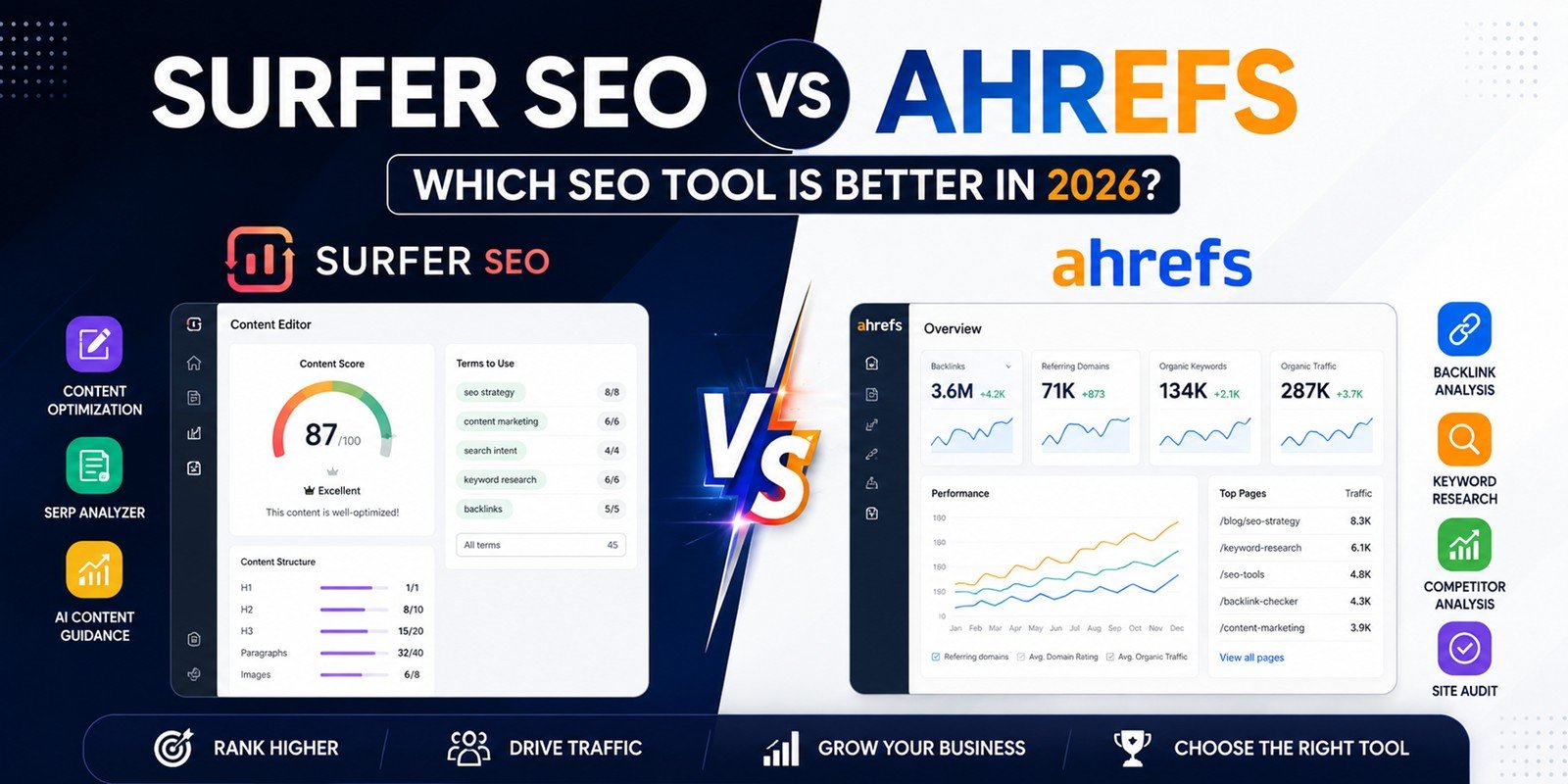
A complete comparison of Surfer SEO and Ahrefs covering SEO features, content optimisation, keyword research, backlink analysis, pricing, and performance for modern marketers in 2026.
Choosing the right SEO software can make or break your content strategy, especially when the tools you rely on directly impact how your clients rank, how fast you produce content, and how much you spend to do it. Two names consistently come up in this conversation: Ahrefs and Surfer SEO. Both are excellent products, but they solve different problems, and picking the wrong one for your workflow is an expensive mistake.
This comparison breaks down both platforms in detail, looking at real features, honest pricing, and the specific contexts where each tool performs best. Whether you run a digital agency, manage an affiliate blog, or offer Medical SEO Services USA, this guide will help you spend your money in the right place.
According to Backlinko, organic search drives over 53% of all website traffic, and the businesses that consistently rank on page one share one thing in common: a disciplined, tool-supported SEO process. The tools you choose shape that process entirely.
What Is Ahrefs?
Ahrefs is one of the most comprehensive SEO platforms available today. Founded in 2011, it built its reputation around backlink analysis and has since expanded into a full-stack SEO suite covering keyword research, site auditing, rank tracking, content exploration, and competitive intelligence.
Agencies and in-house SEO teams in the USA rely heavily on Ahrefs for its data depth. Its backlink index is among the largest in the industry, crawling over 8 billion web pages every 24 hours, according to Ahrefs. This makes it the go-to platform when you need authoritative data on link profiles, organic competitors, and keyword difficulty.
Ahrefs is particularly strong for:
- Researching competitor backlink profiles
- Finding content gaps and keyword opportunities
- Running comprehensive site audits
- Tracking rankings across multiple locations
- Analyzing organic traffic estimates for any domain
It is not primarily a content writing assistant. Ahrefs tells you what to target and why, but it does not guide you through the process of writing and optimizing a specific piece of content in real time.
What Is Surfer SEO?
Surfer SEO launched in 2017 with a focused mission: help writers and SEO professionals create content that ranks by analyzing the on-page signals of top-ranking pages in real time. Rather than being a broad SEO platform, Surfer is a specialized content optimization tool that sits inside your writing workflow.
Its signature feature, the Content Editor, scores your article as you write based on word count, keyword density, NLP terms, heading structure, and other on-page factors drawn from the actual pages ranking for your target query. It also includes a Keyword Research tool, SERP Analyzer, Audit tool, and an AI writing assistant called Surfer AI.
Surfer SEO is particularly strong for:
- Optimizing individual pieces of content against SERP data
- Guiding writers with real-time content scoring
- Identifying missing NLP terms and topical gaps in existing articles
- Running content audits on published pages
- Generating AI-assisted content outlines and drafts
What Surfer does not do particularly well is the wide-angle competitive research that Ahrefs handles with ease. You would not turn to Surfer to explore a competitor’s full link profile or run a domain-level traffic analysis.
Surfer SEO vs Ahrefs: Overview Comparison
| Feature | Ahrefs | Surfer SEO |
| Primary Use Case | Full-stack SEO research and analysis | Content optimization and on-page SEO |
| Backlink Analysis | Industry-leading | Not available |
| Keyword Research | Comprehensive | Basic to intermediate |
| Content Optimization | Limited (Content Grader in beta) | Core product strength |
| Site Audit | Advanced technical audit | Content-focused audit |
| Rank Tracking | Yes, multi-location | Yes, basic |
| AI Writing Support | Limited | Surfer AI included in plans |
| Pricing (entry-level) | $129/month | $89/month |
| Best For | Agencies, enterprise, power users | Content teams, bloggers, agencies |
Key Features Comparison
Keyword Research Capabilities
Ahrefs leads in keyword research by a significant margin. Its Keywords Explorer covers over 170 countries and provides metrics including search volume, keyword difficulty, click-through rate potential, and traffic potential. The Traffic Potential metric is particularly useful because it shows the total monthly search traffic a page ranking in position one could expect, not just the traffic from a single keyword. This distinction matters when you are evaluating whether a topic is worth pursuing.
Surfer SEO includes a Keyword Research feature that clusters topics and groups related keywords into content categories. It is visually intuitive and useful for building content plans, but it lacks the raw data depth of Ahrefs. You cannot analyze historical volume trends, click data, or SERP feature breakdowns inside Surfer the way you can inside Ahrefs.
For keyword research software at a serious professional level, Ahrefs is the stronger choice. Surfer’s keyword tool works well as a complement but should not be your primary research engine.
Content Optimization Features
This is where Surfer SEO earns its pricing. The Content Editor analyzes the top-ranking pages for a given keyword and produces a real-time score based on how well your article matches the on-page signals those pages share. You see exactly which NLP terms are missing, whether your word count is in range, and how your heading structure compares to competitors.
A 2023 study referenced by Surfer’s blog indicated that articles optimized using the Content Editor outperformed non-optimized content in ranking tests. The tool has become a standard part of the workflow for content teams at agencies across the USA.
Ahrefs has a Content Grader feature in development, but as of 2026 it does not match Surfer’s depth when it comes to real-time content scoring. If your agency produces large volumes of optimized content, Surfer SEO is not optional. It is the infrastructure your writers work inside.
Backlink Analysis Comparison
There is no comparison here. Ahrefs is the gold standard for backlink analysis. Its index updates constantly, and the platform lets you see every inbound link to any domain, track new and lost links, evaluate referring domain quality, and analyze anchor text distribution at scale.
Surfer SEO does not offer any backlink analysis. If link building is part of your SEO strategy, and for most businesses it should be, you need Ahrefs or a comparable tool like Semrush. According to Search Engine Land, backlinks remain one of Google’s top three ranking signals, making a reliable link intelligence tool non-negotiable for competitive SEO.
Technical SEO Features
Ahrefs Site Audit is one of the best technical SEO crawlers available outside of specialized tools like Screaming Frog. It identifies crawl errors, redirect chains, missing meta data, duplicate content, page speed issues, Core Web Vitals problems, and more. For agencies running technical SEO campaigns, it covers the majority of what you need in a single platform.
Surfer SEO’s Audit tool is content-focused rather than technical. It evaluates a published page against top-ranking competitors and tells you what content changes to make. It will not flag missing canonical tags, crawl budget issues, or JavaScript rendering problems. For a thorough technical SEO audit, Ahrefs or a dedicated crawler is necessary.
User Interface and Ease of Use
Surfer SEO has a cleaner, more guided interface. New users can get productive within hours because the core workflows are straightforward: enter a keyword, open the Content Editor, write and score. The learning curve is shallow.
Ahrefs has more depth and, consequently, more complexity. It takes longer to understand how to use all of its tools effectively, particularly for someone new to SEO. That said, the interface has improved significantly in recent years, and most experienced SEO professionals find it intuitive after a short adjustment period.
For teams onboarding junior writers or content specialists who do not have a technical SEO background, Surfer is the easier tool to deploy. For experienced SEO strategists who need access to deep data, Ahrefs is worth the learning investment.
Pricing Comparison in 2026
| Plan | Ahrefs (Monthly) | Surfer SEO (Monthly) |
| Entry Level | $129 (Lite) | $89 (Essential) |
| Mid Tier | $249 (Standard) | $129 (Scale) |
| Agency / Advanced | $449 (Advanced) | $219 (Scale AI) |
| Enterprise | Custom pricing | Custom pricing |
| Free Trial | Limited free tools available | 7-day trial available |
Ahrefs is the more expensive platform at every tier. That cost is justified if you are running full-scale SEO campaigns that require deep competitor research and backlink intelligence. If your primary need is content optimization, Surfer SEO delivers significantly more value per dollar.
Many agencies in the USA subscribe to both, treating them as complementary tools rather than alternatives. Ahrefs drives strategy while Surfer drives execution.
Which Tool Is Better for Agencies?
For SEO tools for agencies USA, the honest answer is that most professional agencies need both platforms in their stack.
Ahrefs powers the strategic layer: keyword research, competitor gap analysis, backlink prospecting, and site audits. These functions require a tool with broad data coverage and reliable metrics. Ahrefs delivers that at an agency level.
Surfer SEO powers the production layer: content briefs, writer guidance, content scoring, and publishing-ready optimization. Agencies that produce five or more pieces of optimized content per week cannot afford to skip this step.
According to HubSpot, companies that blog consistently generate 55% more website visitors and 97% more inbound links than those that do not. The compounding return on content investment is high, but only when that content is properly optimized. Surfer makes that optimization process systematic and scalable.
If forced to choose one, agencies with a strong keyword research process already in place should prioritize Surfer for its direct impact on content performance. Agencies that are still building out their research capabilities should start with Ahrefs.
Which Tool Is Better for Bloggers?
For SEO tools for bloggers, budget matters, and so does simplicity. Surfer SEO’s Essential plan gives bloggers access to the Content Editor and basic keyword research at a price point that makes sense for solo operators. The ability to produce content that is already optimized before publishing reduces the time spent on revisions and increases the likelihood of ranking without heavy link building.
Ahrefs is a stronger investment for bloggers who are also doing affiliate marketing or operating in competitive niches where link intelligence and competitor gap analysis are critical to finding angles that can realistically rank. A blogger targeting low-competition keywords in a specific vertical may find that Surfer alone is sufficient for the first six to twelve months.
Which Tool Is Better for Medical SEO Services USA?
Healthcare is one of the most competitive and regulated verticals in USA digital marketing. Agencies offering Medical SEO Services USA face unique challenges: strict compliance requirements, sensitive patient-facing content, high YMYL (Your Money or Your Life) standards from Google, and intensely competitive local markets in cities like New York, Los Angeles, Chicago, Houston, and Miami.
According to Statista, healthcare-related searches on Google number in the billions each year, with patients actively searching for local providers, treatment options, and medical information before making appointments. The practices and health systems that rank consistently for these queries capture a disproportionate share of new patient volume.
For healthcare SEO agencies in the USA, here is how both tools apply:
How Ahrefs Supports Medical SEO
- Competitor analysis: Identifying which hospital systems and private practices are ranking in your client’s geographic area and what their content and link profiles look like
- Keyword research: Finding patient search queries with local intent, such as “orthopedic surgeon in Dallas” or “cardiologist near me accepting new patients”
- Backlink strategy: Identifying local health directories, medical associations, and PR opportunities for link acquisition
- Site audits: Identifying technical issues on medical practice websites that may be suppressing crawl and indexing
- Content gap analysis: Finding topics that local competitors are ranking for that your client’s site does not yet cover
How Surfer SEO Supports Medical SEO
- Content optimization: Ensuring that service pages and blog posts on medical topics meet the on-page standards of top-ranking YMYL content
- NLP optimization: Healthcare content requires careful use of medical terminology. Surfer identifies which terms Google associates with a given topic based on what is already ranking
- Content audits: Evaluating existing pages on a medical website to find which ones need updating to improve their competitive position
- Structured content briefs: Producing clear briefs that healthcare writers and subject matter experts can follow without guesswork
Agencies providing Medical SEO Services USA typically use Ahrefs to build the strategic roadmap and Surfer to execute the content plan. A practice website targeting competitive queries like “urgent care clinic Chicago” needs both the research precision of Ahrefs and the content scoring discipline of Surfer to compete effectively in 2026.
Patient acquisition through organic search is among the highest-ROI marketing channels for healthcare providers. A Google study on health searches found that one in three mobile searches is health-related, underscoring the volume of opportunity for well-optimized medical content.
Real World SEO Examples
Example 1: Multi-Location Healthcare Practice
A regional healthcare group with 12 locations across the Southeast USA wanted to increase new patient appointments through organic search. Their medical SEO agency used Ahrefs to identify that competitors were ranking for several hundred informational queries related to their service lines that the group’s website did not address. The agency built a 60-piece content plan targeting those gaps.
Each article was then produced using Surfer SEO’s Content Editor, ensuring that word count, NLP terms, and heading structure aligned with the top-ranking results for each target query. Within eight months, the group’s organic traffic increased by 41%, and appointment request form completions from organic search grew by 28%.
Example 2: SaaS Company Using Both Tools
A B2B SaaS company offering project management software used Ahrefs to find that several high-volume comparison keywords in their niche had relatively low keyword difficulty scores. They used Surfer SEO to build and optimize comparison pages targeting those queries. Within three months, two of those pages ranked in the top five positions, driving a combined 4,200 monthly organic visitors at a keyword intent that converted at more than twice their site average.
Example 3: Affiliate Blogger in Health Niche
A solo blogger operating a health and wellness affiliate site used Surfer SEO to optimize existing articles that were stuck on page two. By addressing content gaps identified through Surfer’s Audit tool, including missing NLP terms and low word counts relative to competitors, the blogger improved rankings on 14 articles within six weeks. Eight of those articles moved from page two to page one, resulting in a 63% increase in organic traffic month over month.
Pros and Cons of Ahrefs
Pros
- Most comprehensive backlink index in the industry
- Extremely detailed keyword research with click and traffic potential data
- Powerful site audit with technical SEO depth
- Content Explorer for finding top-performing content in any niche
- Accurate rank tracking with SERP history
- Reliable competitive intelligence across any vertical
- Strong data for local SEO research
Cons
- Higher price point than most competing tools
- No real-time content scoring or writing guidance
- Steeper learning curve for newer SEO professionals
- AI writing features are limited compared to Surfer
- Content Grader feature is still developing
Pros and Cons of Surfer SEO
Pros
- Best-in-class content optimization through real-time scoring
- Easy for writers to adopt without deep SEO knowledge
- Content audit tool helps improve existing published articles
- Surfer AI generates content outlines and drafts at speed
- Keyword clustering makes content planning more efficient
- More affordable at the entry level
- Integrates with Google Docs and WordPress
Cons
- No backlink analysis or link building tools
- Keyword research is not as deep as Ahrefs
- Technical SEO audit is limited to content-related issues
- Does not replace a full-stack SEO research tool
- Content score can be gamed if writers prioritize the score over quality
SEO Trends Influencing Tool Selection in 2026
Several shifts in the SEO landscape are directly affecting which tools are worth your investment in 2026.
AI Overviews and Zero-Click Searches
Google’s AI Overviews have significantly reduced click-through rates on certain query types. According to research published by Search Engine Land, the rollout of AI Overviews has contributed to measurable declines in organic clicks for informational queries in some categories. This puts additional pressure on SEO teams to target queries with higher commercial or navigational intent, where AI summaries are less likely to satisfy search intent on their own.
For agencies providing Medical SEO Services USA, this trend makes local and transactional keyword targeting more critical than ever. A query like “best knee surgeon in Philadelphia” is far less susceptible to AI Overview displacement than a broad informational query like “how is ACL surgery performed.”
Topical Authority Over Individual Keywords
Google’s algorithms in 2026 reward sites that demonstrate comprehensive topical authority. Publishing one great article on a subject is no longer enough to rank competitively in saturated niches. Ahrefs’ Content Gap tool is well-suited for identifying the full scope of what a site needs to cover. Surfer’s keyword clustering feature helps organize those topics into an efficient content plan.
E-E-A-T and Healthcare Content
Google’s Search Quality Rater Guidelines place especially high emphasis on Experience, Expertise, Authoritativeness, and Trustworthiness for YMYL content, which includes most medical and healthcare topics. Agencies offering Medical SEO Services USA must pair their technical and content optimization work with credentialing strategies: author bios with verifiable credentials, citations to peer-reviewed sources, and clear editorial processes.
Neither Ahrefs nor Surfer directly addresses E-E-A-T signals, but both tools provide the research and optimization infrastructure that makes high-quality medical content production more efficient and evidence-based.
AI-Generated Content and Quality Floors
The mass adoption of AI writing tools has lowered the average quality threshold for published content across most niches. As a result, genuinely well-researched, accurately optimized, and thoughtfully written content stands out more than it did three years ago. Surfer SEO’s role in this environment is to ensure that human-written or AI-assisted content meets the technical on-page standards to compete. It does not replace editorial quality, but it ensures that quality content is not undermined by avoidable on-page deficiencies.
Final Verdict: Surfer SEO vs Ahrefs in 2026
Both tools are excellent at what they are built to do, and that distinction is the key to making the right decision.
Choose Ahrefs if: You need comprehensive SEO research capabilities, including backlink analysis, deep keyword data, technical site auditing, and competitive intelligence. It is the right tool for agencies that run full-service SEO campaigns, enterprise in-house teams, and anyone who needs to make data-driven strategic decisions across multiple clients or domains.
Choose Surfer SEO if: Your primary need is producing optimized content at scale. It is the right tool for content-focused agencies, bloggers, and SEO teams where the bottleneck is optimization quality during the writing and publishing process rather than strategic research.
Use both if: You are running a professional SEO agency or offering services like Medical SEO Services USA where you need research-grade data to build your strategy and production-grade tools to execute your content plan at scale. Most agencies at the mid-to-advanced level run exactly this stack.
The question is not which tool is better in the abstract. The question is which tool solves the specific problem standing between your current performance and where you want to rank.
Frequently Asked Questions
Is Surfer SEO better than Ahrefs for content optimization?
Yes, for content optimization specifically, Surfer SEO is the stronger tool. Its Content Editor provides real-time scoring based on what the top-ranking pages for your target keyword share in common, including word count, NLP terms, heading usage, and keyword density. Ahrefs does not have a comparable feature for guiding the writing process in real time, though its broader keyword and competitive research capabilities are superior.
Can I use Surfer SEO and Ahrefs together?
Absolutely. This is the most common setup among professional SEO agencies in the USA. The typical workflow involves using Ahrefs for keyword research, competitor analysis, and backlink strategy, then moving into Surfer SEO to create and optimize content based on the topics identified. The tools complement each other rather than overlap significantly.
Which SEO tool is better for agencies managing multiple clients?
Ahrefs is better suited for agencies that need to manage keyword research, audits, and backlink analysis across multiple client accounts. Surfer SEO is better for agencies with high content output that need a standardized system for ensuring every piece of content is optimized before publishing. Large agencies offering full-service SEO, including those specializing in Medical SEO Services USA, typically subscribe to both.
How do healthcare SEO agencies in the USA use Ahrefs and Surfer SEO?
Healthcare SEO agencies use Ahrefs to research patient search behavior, analyze competitor rankings in specific markets, identify backlink opportunities through local health directories and medical associations, and run technical audits on practice websites. They use Surfer SEO to ensure that service pages and blog posts on medical topics meet the on-page standards required to compete in YMYL search results, including proper NLP term coverage, appropriate content depth, and structured heading use that aligns with what Google is already rewarding in that specialty.
Is Ahrefs worth the price in 2026?
For serious SEO professionals, agencies, and businesses competing in any moderately competitive online market, Ahrefs is worth the investment. The data quality, index size, and research capabilities are difficult to replicate at a comparable price point. The Lite plan at $129 per month gives access to the core features, and for most small agencies or advanced freelancers, it covers everything needed for keyword research, competitive analysis, and site auditing. If your only need is content optimization, Surfer SEO delivers more direct value at a lower price.