
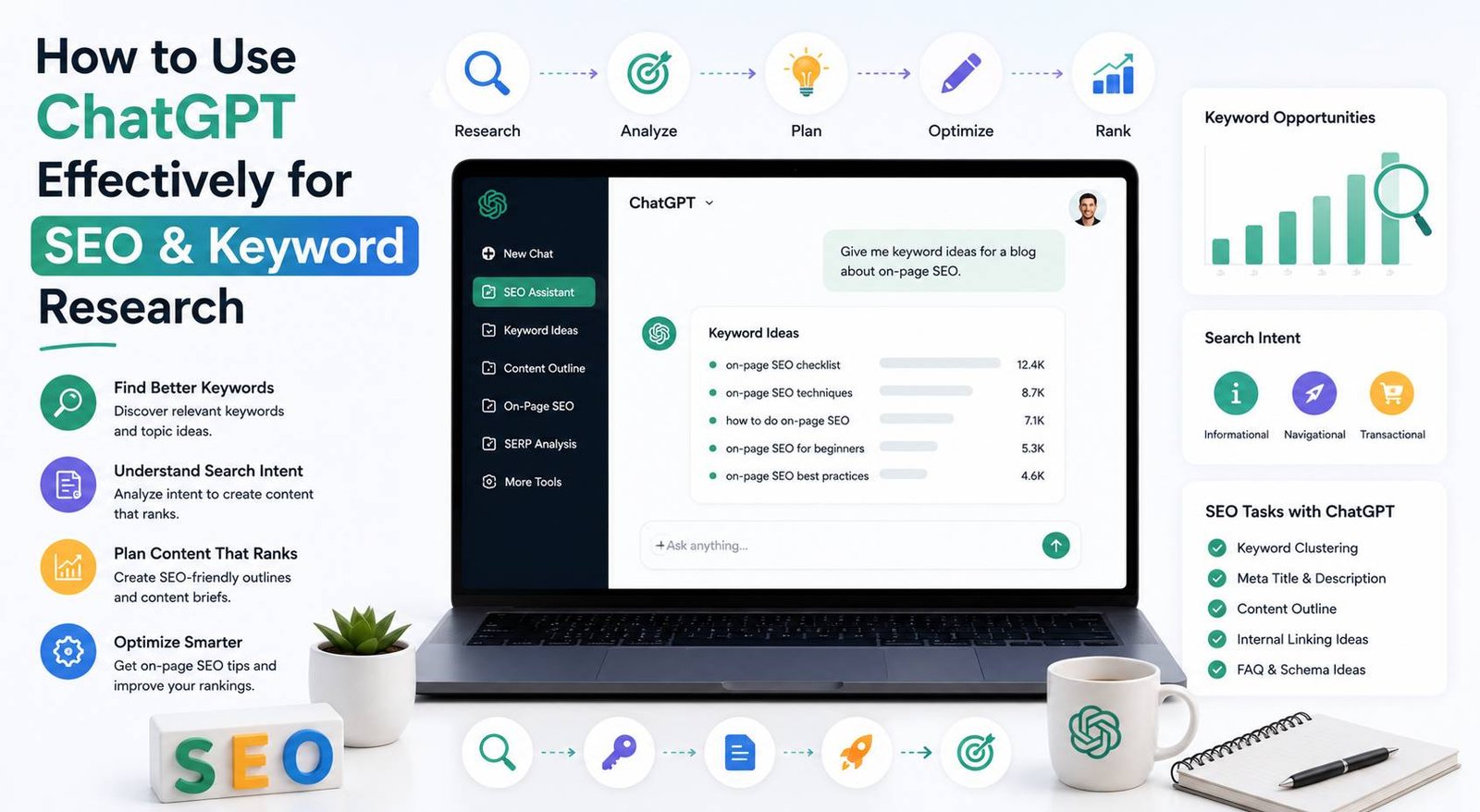
ChatGPT has quietly become one of the most used tools in the SEO world. According to an eMarketer report on a Databox survey, about 86% of US SEO consultants and digital marketers now use ChatGPT alongside traditional platforms like Ahrefs and Semrush.
That is a big shift in just a couple of years. Used the right way, ChatGPT for SEO can speed up almost every part of your workflow, from finding topic ideas to writing briefs and optimizing pages. Used the wrong way, it can fill your site with thin content and fake numbers that hurt your rankings.
This guide shows you the smart approach. You will learn exactly how to use ChatGPT for keyword research, on page optimization, content creation, and strategy, with real prompts you can copy. You will also learn the limits you must respect, because that line is the difference between a tool that helps you rank and one that quietly works against you.
What ChatGPT Can and Cannot Do for SEO
Start with the honest part, because it saves you from costly mistakes. ChatGPT is a language tool, not a live database. It does not have current search volume, keyword difficulty, or your competitors’ rankings. If you ask it “what is the monthly search volume for running shoes,” it may give you a confident number that is completely made up.
So here is the rule that runs through this whole guide. Use ChatGPT for thinking, ideas, structure, and writing. Use real keyword tools for the actual data. When you combine the two, ChatGPT for SEO becomes genuinely useful. When you trust it for numbers, you get burned. Keep that split in mind and everything below will work in your favor.
Using ChatGPT for Keyword Research
This is where many people start, and for good reason. About 63% of SEO professionals already use AI tools for keyword research. ChatGPT will not replace your keyword tool, but it is excellent at the creative and organizing parts that tools handle poorly. Here is how to use ChatGPT for keyword research step by step.
1. Generate seed keywords and topic ideas
Start broad. Describe your niche and audience, and ask for seed topics to explore.
Act as an SEO strategist. I run a blog about home coffee brewing for beginners in the US. Give me 15 broad seed keywords and topic areas I should target. Group them by theme.
2. Find long tail keywords and real questions
Long tail terms are easier to rank for and often convert better. Ask ChatGPT to expand a seed term into specific questions and phrases your readers actually type.
For the seed keyword “pour over coffee,” list 25 long tail keywords and common questions a beginner would search. Include how to, what is, and best questions.
A food blogger in Portland can turn one topic into a month of article ideas this way, then check each one in a real tool.
3. Group keywords into clusters
This is one of the best uses of ChatGPT for keyword research. Paste a messy list of keywords and ask it to organize them into topic clusters, which helps you plan pillar pages and supporting posts.
Here is a list of 40 keywords. Group them into topic clusters, label each cluster, and suggest which one should be the main pillar page and which should be supporting articles.
4. Map the search intent
Ranking depends on matching what the searcher wants. Ask ChatGPT to label each keyword by intent so you create the right type of page.
For each keyword below, tell me the likely search intent: informational, commercial, transactional, or navigational. Then suggest the best content format for each.
5. Validate with real data
Now take your refined list to a real tool. Free options like Google Keyword Planner and Google Search Console give you actual volume and the queries you already rank for. Paid tools like Ahrefs and Semrush add difficulty scores and competitor gaps. This step is not optional. ChatGPT gives you the ideas, the tools give you the truth.
Also Read How to Choose the Right SEO Agency in the USA
Using ChatGPT for On Page SEO
Once you know your target keyword, ChatGPT for SEO shines at the on page work that usually eats your afternoon.
Title tags and meta descriptions
Ask for several options and pick the best, then tweak it.
Write 5 title tag options and 3 meta descriptions for an article targeting the keyword “best budget espresso machines.” Keep titles under 60 characters and meta descriptions under 155 characters. Make them click worthy without sounding like clickbait.
Content outlines and briefs
A strong outline is half the battle. Ask ChatGPT to build a structure based on search intent and the questions people ask.
Create a detailed blog outline for the keyword “how to descale a coffee maker.” Include H2 and H3 headings, the questions to answer, and a short FAQ section for People Also Ask style queries.
FAQ sections and People Also Ask
FAQs help you capture extra queries and can earn rich results. Ask ChatGPT to draft questions and concise answers, then fact check each one yourself.
Schema and internal linking ideas
ChatGPT can suggest the type of schema markup that fits your page, like FAQ or HowTo, and even draft the JSON for you to review. It can also suggest internal links if you paste a list of your existing post titles and ask which ones connect naturally to your new article.
Optimizing content you already have
Do not forget your old posts. Paste an underperforming article and ask for ideas.
Here is an existing blog post. Suggest how to improve it for the keyword “cold brew ratio,” including a better title, missing subtopics, and places where the intent is not fully answered.
Using ChatGPT for Content That Actually Ranks
You can absolutely use ChatGPT to draft content, but how you do it decides whether you rank or sink. Google does not punish AI content for being AI. It rewards content that is genuinely helpful and demonstrates real experience, expertise, authority, and trust. Thin, generic articles lose, no matter who or what wrote them.
The winning approach is simple. Use ChatGPT for the first draft and the structure, then add what it cannot: your real experience, original examples, current data, screenshots, and a human edit that makes it sound like you. A SaaS marketer who adds real product insights and customer quotes to an AI draft ends up with something far stronger than a competitor who publishes raw output. The survey data backs this up too, since the vast majority of marketers review and edit AI content before it goes live.
Using ChatGPT for SEO Strategy and Technical Help
Beyond writing, ChatGPT for SEO can support the technical and planning side of your work.
- Competitor analysis prompts. Paste a competitor’s headings and ask where their content has gaps you can fill.
- Content audits. Ask it to group your existing posts by topic and flag where you have overlap or thin coverage.
- Regex and formulas. Ask for a regex pattern for Search Console filtering or a spreadsheet formula to sort keyword data.
- Plain English explanations. Confused by canonical tags, redirects, or robots files? Ask for a simple explanation before you make a change.
- Outreach and link building. Draft personalized outreach emails for guest posts or digital PR, then edit them so they sound human.
A Simple ChatGPT SEO Workflow
Put it all together with this repeatable process.
- Brainstorm seed topics and long tail keywords with ChatGPT.
- Validate volume and difficulty in Google Keyword Planner, Ahrefs, or Semrush.
- Cluster the winning keywords into pillar and supporting topics.
- Brief each article with an outline and target intent.
- Draft with ChatGPT, then add your own expertise and examples.
- Optimize titles, meta, headings, FAQs, and internal links.
- Publish and track performance in Search Console, then update as needed.
Mistakes That Hurt Your Rankings
Avoid these and you stay on the safe side.
- Trusting fake metrics. Never use search volume or difficulty numbers from ChatGPT. They are guesses.
- Publishing unedited drafts. Raw output reads generic and adds no real value. Always edit and add your own insight.
- Ignoring search intent. A great article on the wrong intent will not rank. Match the format to what people want.
- Keyword stuffing. Asking ChatGPT to cram a keyword in twenty times reads badly and helps nothing.
- Skipping fact checks. ChatGPT can invent stats, sources, and quotes. Verify every claim before publishing.
Respect the Limits and Stay Accurate
ChatGPT can sound completely certain and still be wrong. It may produce outdated facts, fake citations, or made up data. Treat it as a sharp assistant who occasionally makes things up, because that is exactly what it is. Pair it with real tools, verify the facts, and keep a human in charge of the final call. That habit is what separates people who win with ChatGPT for SEO from those who get a quick win and then a painful ranking drop.
Frequently Asked Questions
Can ChatGPT do keyword research on its own?
It can brainstorm keywords, questions, and clusters very well, but it cannot give accurate search volume or difficulty. Use ChatGPT for keyword research ideas, then validate the numbers in a real tool like Google Keyword Planner, Ahrefs, or Semrush.
Is using ChatGPT for SEO content against Google’s rules?
No. Google focuses on whether content is helpful and trustworthy, not on how it was made. The key is to edit AI drafts, add real expertise and examples, and avoid publishing thin, generic pages.
What is the best way to use ChatGPT for SEO?
Use it for ideation, outlines, briefs, title and meta options, FAQs, and first drafts. Then add your own experience, verify all facts, and pair it with real keyword and analytics tools for the data.
Will ChatGPT give me accurate search volumes?
No. Any volume or difficulty figure it provides is unreliable and often invented. Always confirm with a dedicated keyword tool.
Can ChatGPT help optimize my existing content?
Yes. Paste an underperforming post and ask for a better title, missing subtopics, and gaps in search intent. It is one of the fastest ways to refresh old articles.
Final Thoughts
ChatGPT for SEO and keyword research is a real advantage when you use it for what it does best and lean on proper tools for the rest. Let it handle the brainstorming, the structure, and the first draft, then bring in real data, your own expertise, and a careful edit. That combination is faster than the old way and stronger than raw AI output. Pick one task from this guide, like clustering a list of keywords or drafting five title tags, and try it on a real project today. The time you save will free you up to focus on the strategy that actually moves rankings.