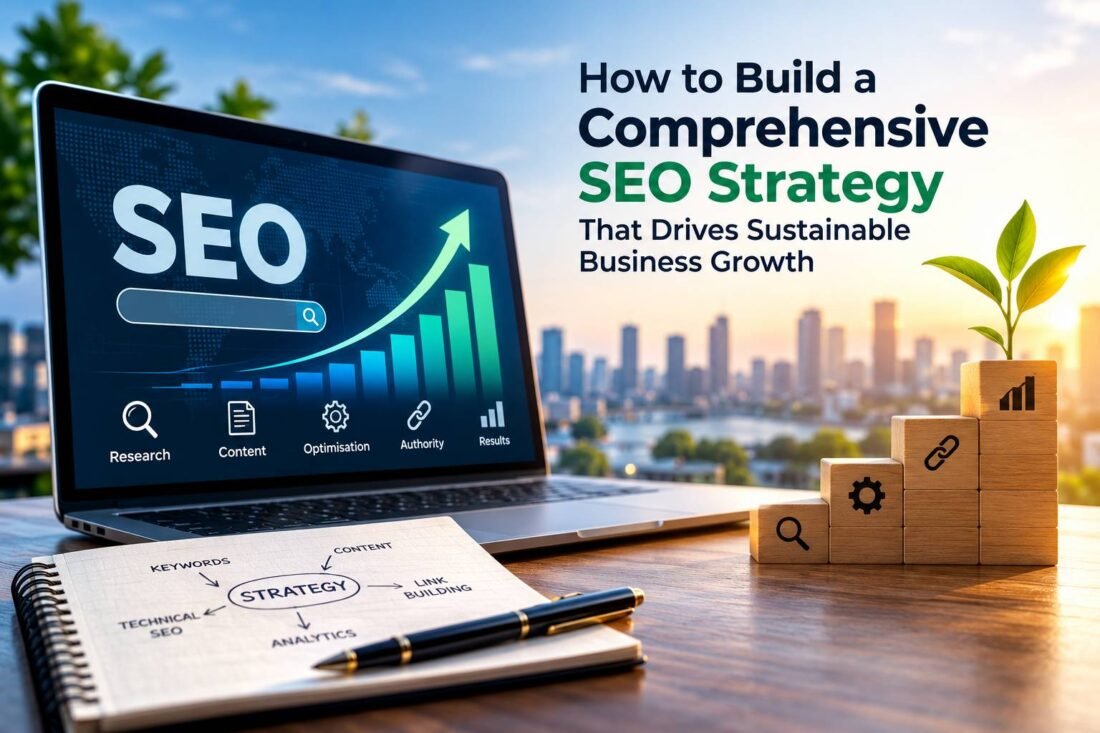
Many businesses treat search engine optimization as a checklist: tweak a few title tags, publish a handful of blog posts, and wait. When results stall, they blame the algorithm. The more common problem is that the work was never coordinated. A comprehensive SEO strategy treats technical health, content, authority, local presence, and measurement as parts of one system, each supporting the others.
The logic is straightforward. Organic visibility earns clicks from people already searching for what you offer. Those clicks become relevant traffic when your pages match what the searcher actually wants. Relevant traffic becomes qualified leads or sales when the site is fast, trustworthy, and clear about the next step. Over time, that chain compounds, which is why a well-built search engine optimization strategy tends to outperform short-term tactics on cost and durability.
This guide walks through nine components of an SEO strategy for business growth, explains how they connect, and offers practical steps you can apply whether you run a local service company, an online store, or a B2B brand. No one can promise specific rankings, but a disciplined strategy gives you the best chance of building organic search traffic that holds up through algorithm changes.
1. Understand Your Business Goals and Target Audience
Every effective strategy starts outside the search engine. Before you look at a single keyword, decide what the business needs from organic search. That might be more demo requests, higher online revenue, more calls from a specific city, or lower dependence on paid advertising. Each goal leads to different priorities.
Set Measurable SEO Objectives
Vague aims such as “get more traffic” are hard to manage. Tie objectives to outcomes the business already tracks: qualified form submissions, phone calls, product revenue, or booked appointments. Then define the SEO metrics that feed them, such as non-branded clicks, visibility for priority topics, and conversion rate on organic landing pages. A target like “increase organic demo requests by a defined amount within two quarters” gives the team something concrete to plan around.
Define Your Audience and Search Intent
Build simple buyer personas from real conversations with sales staff, support tickets, and customer interviews. Note what each group is trying to solve, what vocabulary they use, and what objections they raise. Customers rarely describe a problem the way a company describes its product.
Then map those needs to search intent optimization. Searches generally fall into four patterns:
- Informational: the searcher wants to learn something, such as “how does a heat pump work.”
- Commercial investigation: the searcher is comparing options, such as “best project management software for small teams.”
- Transactional: the searcher is ready to act, such as “buy standing desk” or “book HVAC repair.”
- Navigational: the searcher is looking for a specific brand or site.
A page that targets the wrong intent will struggle however well it is optimized. A product page will rarely satisfy someone who wants a beginner’s explanation, and a long guide will frustrate someone ready to purchase.
Research Competitors and Keyword Opportunities
Competitor research shows which topics the market rewards and where gaps exist. Review the pages that consistently appear for your priority queries. Look at what they cover, how they structure information, and what they leave out. Gaps in depth, freshness, or practical guidance are often your best openings. Prioritize keywords by a mix of relevance to the business, realistic difficulty, and likely value rather than by search volume alone. A low-volume query with strong buying intent can be worth more than a broad term that attracts casual browsers.
2. Incorporate AI SEO Into Your Search Strategy
Search is no longer limited to a list of ten blue links. Google now shows AI-generated overviews for many queries, and people also turn to conversational assistants for research and recommendations. These experiences summarize information from multiple sources and often cite the pages they draw on. For businesses, that changes where visibility happens and how users first encounter a brand.
What Actually Changes With AI-Powered Search
The fundamentals matter more than any single trick. Google’s own guidance for site owners says that the same foundational practices that support traditional search apply to its AI features: crawlable pages, helpful original content, and a good page experience. There is no special markup that guarantees inclusion in an AI summary. What does change is the premium on content that answers questions directly, demonstrates real expertise, and is easy for a machine to interpret.
Some teams find it useful to bring in outside specialists to adapt their content and site structure for these new formats, and ai seo services are one option for that, but the underlying work still comes down to clarity, accuracy, and authority on the topics you want to be known for.
Focus on Entities and Topical Relevance
Search systems increasingly understand the web in terms of entities, meaning distinct things such as brands, people, products, places, and concepts, and the relationships between them. To strengthen how your business is understood:
- Describe your company, products, and services consistently across your site, social profiles, and third-party listings.
- Cover a topic thoroughly instead of publishing disconnected posts on loosely related keywords.
- Use clear headings, concise definitions, and direct answers to common questions near the top of relevant sections.
- Add structured data where it accurately describes the content, including Organization, Article, Product, and FAQ-style information when it genuinely applies.
Protect Accuracy and Authority
AI systems tend to rely on sources that are consistent, specific, and well corroborated. Review your key pages for outdated claims, vague statements, and unsupported assertions. Attribute facts to credible sources, show who wrote the content and why they are qualified, and keep pricing, policies, and service details current. Being cited by other reputable sites reinforces the same signals. Strong, accurate content serves traditional rankings and AI-driven discovery at the same time.
3. Strengthen Your Local Search Visibility
For businesses serving customers in specific areas, local search often drives the most valuable traffic. Google describes local results as depending largely on relevance, distance, and prominence. You cannot change where a searcher is standing, but you can influence the other two factors considerably.
Optimize Your Google Business Profile
Your Google Business Profile is frequently the first thing a local customer sees. Choose the most accurate primary category, add secondary categories where they fit, write a clear business description, and list services and hours precisely. Add real photos, keep holiday hours updated, and use features such as posts, products, and Q&A thoughtfully. An incomplete or inaccurate profile can cost you calls and visits regardless of how good your website is.
Build Location Pages and Research Local Keywords
If you serve multiple cities or operate several locations, give each its own landing page with unique, useful content: the specific address or service area, local team members, relevant projects, and details that matter to that community. Avoid cloning one page and swapping city names, as thin duplicates add little value. Local keyword research should look at how customers phrase requests in each area, including neighborhood names and “near me” patterns.
Businesses that lack in-house capacity to manage profiles, citations, and location pages across several markets sometimes turn to local seo services, though the most important step is simply keeping the information accurate everywhere customers might find you.
Manage Citations, Reviews, and Reputation
Consistency of name, address, and phone number (NAP) across directories, data aggregators, and your own site helps search engines trust your details. Audit major listings periodically and correct conflicts, especially after a move or phone change. Reviews matter for both rankings and conversions. Ask satisfied customers for feedback at natural moments, respond to every review professionally, and treat criticism as operational information. Never buy or fabricate reviews, since that violates platform policies and damages trust.
4. Build a Strong Technical SEO Foundation
Technical SEO ensures search engines can find, understand, and serve your pages. Excellent content on a site with crawling or indexing problems will underperform, so this layer deserves early attention.
Crawling, Indexing, and Site Architecture
Search engines discover pages by following links and reading sitemaps, then decide which to index. Keep important pages within a few clicks of the homepage, use logical categories, and create short, readable URLs that reflect the page hierarchy. Internal linking spreads authority and helps both users and crawlers understand which pages matter most. Use descriptive anchor text rather than generic phrases such as “click here.”
For sites with complex templates, large catalogs, or migration risks, specialized technical seo services usa providers can diagnose rendering and crawl issues, although many fixes begin with a careful review of the basics described here.
Sitemaps, Robots.txt, and Canonical Tags
An XML sitemap lists the URLs you want indexed and helps search engines find them efficiently. Keep it limited to canonical, indexable pages that return a normal status. The robots.txt file controls crawling, not indexing, so it is not the right tool for keeping a page out of search results. For that, use a noindex directive or authentication. Canonical tags tell search engines which version of a page to treat as primary when similar content exists at multiple URLs, such as tracking parameters or print versions.
Page Experience, Mobile Usability, and Structured Data
Core Web Vitals measure loading performance (Largest Contentful Paint), responsiveness (Interaction to Next Paint), and visual stability (Cumulative Layout Shift). Treat them as a user experience guide rather than a score to chase. Compress images, limit heavy scripts, reserve space for ads and embeds, and test on real mobile devices, since most searches now happen on phones. Finally, add schema markup that accurately reflects visible page content so search engines can interpret details such as products, reviews, events, and organizations.
5. Develop an Effective Ecommerce SEO Strategy
Online stores face challenges that most other sites do not: thousands of similar pages, constantly changing inventory, and URL variations created by filters. A sound ecommerce approach begins with structure and keyword focus.
Category and Product Page Optimization
Category pages usually capture broader, high-intent searches such as “women’s trail running shoes,” while product pages capture specific model or attribute searches. Give each category a clear target, a helpful introduction, and well-organized product listings. On product pages, write original descriptions that address real buyer questions about size, materials, compatibility, and use. Manufacturer copy pasted across many retailers gives search engines little reason to prefer your page.
Stores with large catalogs or frequent platform changes may look to ecommerce seo services usa specialists for help prioritizing templates and scaling these improvements, but the core principle remains the same: every important page needs a distinct purpose and useful content.
Product Schema, Images, and Internal Linking
Product structured data can communicate price, availability, ratings, and other attributes so search engines can display them accurately. Ensure the markup matches what shoppers see on the page. Optimize images with descriptive file names, meaningful alt text, appropriate dimensions, and modern compression formats. Link related products, parent categories, and buying guides to each other so that authority flows to the pages that drive revenue.
Faceted Navigation and Product Lifecycle
Filters for size, color, and price are valuable to shoppers but can generate enormous numbers of near-duplicate URLs. Decide which combinations deserve to be indexed because they match real search demand, and control the rest with canonical tags, noindex directives, or crawl rules, applied carefully. Handle retired inventory deliberately:
- Temporarily out of stock: keep the page live, show clear availability messaging, and offer alternatives or restock notifications.
- Permanently discontinued with a close replacement: redirect to the most relevant successor product or category.
- Permanently discontinued with no replacement: return an appropriate 404 or 410 status, or redirect to the relevant category if it serves users well.
6. Build Website Authority Through Quality Link Building
Links from other reputable sites remain one of the clearest signals that your content is worth citing. Relevance and editorial context matter far more than volume. A few links from respected publications in your industry are worth more than hundreds from unrelated or low-quality sources.
Earn Links Through Value, Not Tricks
The most sustainable approach is to create something people want to reference: original research, practical tools, expert commentary, or well-documented guides. Digital PR extends this by pitching newsworthy angles, expert quotes, or data to journalists and editors. Industry associations, trade publications, and reputable local business directories can also provide legitimate, relevant mentions.
Because outreach takes time and relationship building, some companies engage link building services to supplement internal efforts, but whichever route you take, the standard should be editorial merit rather than transactional placements.
Learn From Competitors and Keep the Profile Natural
A competitor backlink analysis reveals which sites link to similar businesses and what types of content attract those links. That tells you where realistic opportunities lie. Pay attention to anchor text variety. A natural profile includes branded anchors, URLs, descriptive phrases, and generic terms, not repeated exact-match keywords. Avoid practices that Google’s spam policies address, such as buying links that pass ranking credit, participating in link schemes, or using automated link generation. The short-term gain is rarely worth the risk of a manual action or lost trust.
7. Conduct Regular SEO Audits and Identify Growth Opportunities
Even a well-run site accumulates problems over time: broken links, redirect chains, outdated pages, and overlapping content. Regular audits catch these issues before they cost traffic. Many teams schedule a full review once or twice a year, with lighter monthly checks on key indicators.
When an internal team lacks the time or tools for a complete review, seo audit services can provide an outside perspective, though the audit itself is only valuable if its findings lead to prioritized action.
What a Useful Audit Covers
- Technical review: crawl errors, server responses, site speed, mobile rendering, and structured data validity.
- Indexing and crawling analysis: which pages are indexed, which are excluded and why, and whether crawl budget is wasted on low-value URLs.
- On-page analysis: title tags, headings, content depth, intent alignment, and internal links.
- Keyword cannibalization: multiple pages competing for the same query, which can split signals and lower performance for each.
- Backlink assessment: link quality, toxic patterns, lost links, and gaps compared with competitors.
- Competitor performance: where rivals are gaining visibility that you are not.
Prioritize by Business Impact
Audits can surface hundreds of issues, and treating them all equally wastes effort. Rank findings by their likely effect on revenue-driving pages, the effort required, and any risk involved. A noindex tag accidentally applied to a top product category deserves immediate attention. A missing alt attribute on a decorative image does not. Assign owners and deadlines so the audit becomes a working roadmap rather than a document that sits on a shelf.
8. Create a Sustainable Content Marketing Strategy
Content is how a business answers the questions its customers are already asking. A sustainable content marketing strategy goes beyond publishing on a schedule. It organizes topics, matches formats to intent, and keeps existing material accurate over time.
Organize Content Into Topic Clusters
A pillar page covers a broad subject comprehensively, while cluster pages explore specific subtopics in depth and link back to the pillar. This structure signals expertise on a theme and makes it easy for readers to move from general understanding to specific answers. For example, a financial software company might build a pillar on small business accounting, with clusters covering invoicing, payroll, tax preparation, and expense tracking.
Companies that want help planning clusters and producing consistently strong material sometimes consider content marketing services, yet whoever creates the content, the editorial standard should remain the same: original, accurate, and genuinely useful to the reader.
Match Content to Search Intent
Different funnel stages call for different formats. The table below shows a practical way to plan coverage.
| Intent Type | Typical Searcher Goal | Suitable Formats | Primary Success Metric |
|---|---|---|---|
| Informational | Learn or understand a topic | Guides, tutorials, glossaries, explainers | Organic visits and engaged sessions |
| Commercial | Compare options and evaluate providers | Comparisons, reviews, case studies, buyer guides | Assisted conversions and email signups |
| Transactional | Purchase or request a service | Product pages, service pages, pricing pages | Leads, sales, and revenue |
Maintain Quality, Refresh Regularly, and Plan Ahead
Originality comes from first-hand experience, proprietary data, expert contributions, and real examples, not from rewording what already ranks. Review high-value pages on a regular cycle and update statistics, screenshots, recommendations, and links that have aged. Updating a page that already has some authority is often more efficient than writing a new one from scratch.
An editorial calendar keeps the effort organized. Plan topics around business priorities and seasonality, assign clear ownership, and build in time for review. Distribution matters as well. Share new content with email subscribers, relevant communities, and partners, and link it internally from related pages so that it gets discovered quickly and passes value where it counts.
9. Measure SEO Performance and Continuously Improve
SEO performance tracking turns a strategy into something you can manage. Without it, teams drift toward activity instead of results. The goal is to connect search behavior to business outcomes and adjust accordingly.
Metrics Worth Tracking
- Organic search traffic and impressions: are more people seeing and visiting your pages?
- Keyword visibility and rankings: track groups of priority terms rather than obsessing over single positions.
- Click-through rate: low CTR on a high-impression page often signals a title or description that needs work.
- Conversion rate and lead quality: traffic only matters if it produces outcomes the business values.
Use the Right Tools Together
Google Search Console shows how your site performs in search, including queries, impressions, clicks, indexing status, and page experience reports. Google Analytics 4 shows what visitors do after they arrive, including engagement, events, and conversions. Used together, they let you see which queries bring valuable visitors and which pages fail to convert them. Set up conversion events in GA4 for actions such as form submissions, calls, and purchases, and review the data in a consistent monthly report that highlights trends, wins, issues, and next steps rather than raw numbers alone.
Adjust Priorities Based on Results
Let the data redirect effort. If a topic cluster is gaining impressions but not clicks, rework titles and snippets. If traffic is healthy but conversions lag, examine page clarity, calls to action, and intent alignment. If a technical fix produced gains, look for similar issues elsewhere. SEO results usually build gradually, so judge progress over meaningful periods and avoid reacting to every short-term fluctuation.
Conclusion: Build an SEO Strategy That Supports Long-Term Business Growth
The components covered here are not separate projects competing for budget. Technical optimization makes your site accessible, content development gives people reasons to visit, authority building shows that others trust you, local visibility connects you with nearby customers, and AI search optimization helps your expertise surface in newer discovery formats. Measurement ties it all together and shows where to invest next.
The businesses that benefit most from search tend to treat it as an ongoing discipline rather than a one-time campaign. Start with clear goals, fix the foundations, publish content that deserves to be found, and review results honestly. Done consistently, that approach builds sustainable SEO growth that continues to support the business long after any single tactic loses its edge.
Published by Professional SEO India.